Showing posts with label War. Show all posts

October 15, 2012

12 Bright Victory (1951)

***
Country: US
Director: Mark Robson
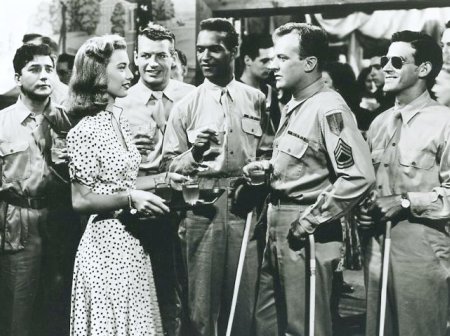
Several months ago I wrote about Marlon Brando's first film, The Men (1950), a picture about a paraplegic World War II veteran and the problems he faces adjusting to his disability. Just a year after that film was made, a very similar film on the same subject was made, Bright Victory, about a soldier who has been blinded in North Africa in 1943. Not having seen Bright Victory in many years, I watched it last week when it was shown on TCM as part of the channel's series on disability in film. Because the two films deal with such a similar subject and have many elements and even scenes in common, a direct comparison was inevitable. Even though I found both pictures to be good, I would have to say that in all respects The Men is the better film.

Arthur Kennedy stars as the war veteran, Larry Nevins, who is ambushed by German snipers. The two other men in his Jeep are killed, and Nevins receives serious wounds to his eyes. (One of the men in the Jeep is played by 25-year old Rock Hudson in one of the last bit parts he had at Universal before becoming a featured player and then one of the studio's biggest stars.) When Larry is first told by doctors that he is completely blind, his reaction is a bad one, and these scenes are some of the few highly emotional ones in a picture that is generally restrained about its subject. Sent to the veterans' hospital in Valley Forge, he goes through an intensive training course to help him cope with his disability. As in The Men, these scenes have a documentary feel. While at Valley Forge, Larry meets Judy Greene (Peggy Dow), a young woman who works as a volunteer at the hospital, and the two soon develop a close friendship.

After the training course Larry returns to his family in Florida, where he is engaged to a young woman, Chris Paterson (Julie Adams), whom he hasn't seen in more than two years. After films like The Best Years of Our Lives and The Men, the problems he faces in his return to civilian life have an air of familiarity. Larry has accepted his disability and is managing to cope with its challenges, but his parents and the people around him don't have such an easy time of it. His fiancée's wealthy family in particular are dismissive of his ability to rejoin the mainstream and don't hide their displeasure at the prospect of the marriage. Chris doesn't seem to share this attitude, but she is strongly under the influence of her parents, and it's not totally clear whether her feelings for Larry are more love or loyalty. At the same time, Larry yearns to do something more meaningful with his life than work for his in-laws in a job that is the result of patronage, and he is inspired by the success of a blind lawyer to consider taking up law studies. As the film proceeds, we see how Larry arrives at the decisions that will determine his future.

Chris (Julie Adams) and Larry (Arthur Kennedy)

Bright Victory has an exceptionally able cast—including James Edwards, Will Geer, Minor Watson, Richard Egan, and Jim Backus—but this is Arthur Kennedy's show all the way. A stage actor brought to the attention of Warner Bros. by James Cagney, who wanted him to play the younger brother in City for Conquest (1941), Kennedy went on to work over the next twenty years with some of the best film directors in the business. He became one of the most reliable supporting actors in Hollywood, continuing as he began with Cagney by playing second lead to stars like Bogart, Kirk Douglas, James Stewart, and Robert Mitchum, and earning four Oscar nominations for best supporting actor. Bright Victory, the second of four films Kennedy made with director Mark Robson, was one of the few times he was given a lead role, and it got him an Oscar nomination as best actor. (He lost to Humphrey Bogart in The African Queen but was named best actor by the New York Film Critics, in the view of some as an alternative to Marlon Brando's controversial performance in A Streetcar Named Desire.)

Kennedy is superb in the picture. If his performance lacks the impact of Brando's in The Men—and it does—it's not because of his acting, but because of deficiencies in the conception of the character. Brando's Bud Wilocek is isolated from the people around him by his despair, a tortured individual whose attempt to adjust to his disability is a soul-challenging struggle. Kennedy's Larry in Bright Victory might initially be devastated by the realization that he is totally blind, but in contrast to Bud in The Men, he is a resilient, confident person who quickly confronts and masters the challenges of his changed circumstances. Like Bud he has to cope with hurtful reactions to his condition by those around him, but any internal struggle he might experience is soon resolved. This removes from the situation the constant inner torment that made Brando so compelling in The Men.

Instead, the writers (the film is based on a novel by Baynard Kendrick) inject a couple of tangential subjects to intensify the element of conflict. One is racial prejudice. Early in the film, Larry, a native Floridian, unknowingly sits next to an African American soldier on the train to the hospital at Valley Forge. When he realizes the race of the man he has been chatting to in a friendly way, Larry shuns him. Later this trite situation of the blind person not recognizing race is repeated when Larry unwittingly becomes friends with a blind African American soldier in the hospital, Joe Morgan (James Edwards), then shuns him too when he discovers his race. At the end of the movie there is a pat reconciliation scene in which Larry suddenly abandons his lifelong bigotry and again becomes friends with Joe. This subplot is so compressed that it just doesn't ring true. It's an inadequate way of addressing an issue that might have seemed less of an afterthought had it been more explicitly connected to the film's theme of tolerance, with the change in Larry's attitude explained in a more psychologically convincing way. Instead it seems a contrivance intended to distinguish Bright Victory from similar films and, worse, a distraction from the film's main theme.

Another subplot that diverts attention from the main subject of the film is the well-worn love triangle. Judy, the young hospital volunteer Larry meets at Valley Forge, plainly has romantic feelings for Larry. Yet although he flirts with her, he seems oblivious to her emotions. Even after he does finally recognize the true nature of her feelings, he still chooses to return to his fiancée and his former way of life in Florida. But when he goes back briefly to Valley Forge, they meet up again, and in fact it is Judy who introduces him to the blind lawyer who causes him to rethink his plans for the future, including his engagement to Chris. The whole love-triangle subplot makes Bright Victory seem a more conventional picture than The Men. And like Larry's racial bigotry, it's a measure of a lack of confidence in the power of the subject of disability to carry the film by itself.

Bright Victory lacks not only the thematic focus of The Men, but also the more truthful tentativeness of that film's conclusion. The Men ends hopefully but uncertainly. Things might work out for Brando's Bud. But we get the idea that if they do, it won't be easily, it won't be without problems further along, and it won't be with any permanent sense of security. With its more optimistic outlook, Bright Victory leaves us feeling much more comfortable than does The Men. Despite Larry's problems, in comparison to Bud his future seems predictable and upbeat. There never seems much doubt that Larry will overcome his problems, and that's why in the end his victory over adversity seems entirely too easy.


June 29, 2012

19 Complete Reality: The War Documentaries of William Wyler

The Memphis Belle (1944)


Only days after the December 7, 1941 attack on Pearl Harbor, William Wyler, who had begun shooting Mrs. Miniver less than a month earlier, applied to the Army Signal Corps as a volunteer. In the event, Wyler was eventually turned down by the Signal Corps, and other projects he tried to develop to help the war effort, including a film for Frank Capra's series Why We Fight, didn't come to fruition. But in June 1942 he was introduced to Major General Carl A. Spaatz, who was organizing Army Air Forces operations in Great Britain, which he invited Wyler to document. After summarily being made a Major in the AAF, Wyler rounded up equipment and a four-man technical crew in Hollywood and left for Britain, arriving in August just as the first American B-17 Flying Fortress bombers began flying combat missions over the Continent.

Between early 1943 and the time aerial filming was completed at the end of May, Wyler and his film crew flew in several B-17 bombing raids, two of them in a B-17 nicknamed the Memphis Belle. The discomfort, not to mention the danger, endured by Wyler and his film unit on these missions was extreme. The noise from the engines was deafening and communication inside the plane impossible without an intercom. Unlike modern aircraft, the B-17 was not pressurized or heated, yet needed to fly at high altitudes, so crews had to wear bulky pressure suits to protect them from below-freezing temperatures and to carry around heavy oxygen tanks. The pressure suits and oxygen tanks, combined with the cramped interiors of the planes and the lack of oxygen at high altitudes, made for miserable working conditions for members of the film unit. "Taking three steps was like walking a mile," Wyler later said (Stevens 211).

The actual filming involved even more difficulties. The handheld cameras, which held only enough film to shoot about three minutes of footage, had to be reloaded frequently and at minus sixty degrees Fahrenheit inside the B-17 often froze. Moving from one side of the plane to the other to shoot completely changed the light exposure. The speed at which enemy fighters came at the bomber meant they were often past before they could even be filmed. Above all, the tremendous personal courage of Wyler and his crew cannot be overstated. Over 80% of the planes in the group they were flying with were lost, and the unit's sound engineer was killed when the plane he was flying in was shot down returning from France. Wyler in particular showed a remarkable willingness to take risks, although he evidently didn't see himself as especially brave. "You didn't even think of the danger," he said in an interview at the American Film Institute. "There wasn't time; you only thought of getting it on film" (Stevens 212).

From the beginning Wyler aimed for absolute authenticity. "Of course it was the real thing," he explained. "It was all done under the conditions of complete reality" (Stevens 211-12). Rather than a newsreel-style documentary, General Spaatz wanted Wyler to emphasize the human element of the soldiers flying these dangerous missions. With this is mind, Wyler decided to structure the film around the idea of a crew flying their twenty-fifth mission, after which their tour of duty would be over, and began to look around for a plane whose crew were nearing the end of their tour. There were several possibilities, but when he got a good look at the pinup-like figure painted on the nose of the Memphis Belle, his unerring instinct for telling visual detail told him he had found his plane and crew.

In June 1943 Wyler returned to California to fashion a picture from the 19,000 feet of film he had, silent and shot in 16mm after the equipment he had assembled in Hollywood was lost in transit to Britain and never recovered. He brought the crew of the Memphis Belle to Hollywood to record voice-over dialogue for the film, which had now been blown up to 35mm. His original intention of a two-reel picture, though, quickly became more ambitious. To the dialogue of the plane's crew, Wyler added sound effects, music, and voice-over narration, tightened the initial seven reels to four (about 40 minutes), and pressed for commercial distribution of the film, tentatively titled Twenty-Five Missions.

After a special screening at the White House which left FDR deeply moved, the President agreed: "This has to be shown right away, everywhere," he told Wyler (Herman 265). Retitled The Memphis Belle, the film opened in April 1944 in New York, where it received an unprecedented front-page rave review by Bosley Crowther, in which he called it "thorough and vivid" and praised its "real and exciting detail." The Memphis Belle was later shown in more than 16,000 theaters in the U.S. In 2001 it was added to the National Film Registry.

The Memphis Belle covers one day in the lives of a B-17 bomber crew as they fly the last mission of their tour of duty before shipping home. It documents step by step a high-altitude daylight bombing raid on the submarine base at Wilhelmshaven in northern Germany, beginning with the ground crew prepping the plane at an air base in Britain on the morning of the mission. Early in the film we are introduced individually to the ten members of the plane's crew, who are presented as ordinary men not much different from people the viewer is likely to know. While keeping our attention firmly on these men and their activities, Wyler manages to subtly include a great deal of factual detail about the nature of aerial warfare—"the new battle front: the air front."

Even though Wyler frames the film as the story of the air raid told from inside the Memphis Belle, he places its role in the raid clearly in the context of the complex operation of which it is only one element, one plane of the one thousand taking part. The explanation of the operational procedures involved in the mission is detailed, lucid, and concise. Wyler deftly balances information and narrative, using the skill at succinctly making his point through potent images that was evident in the studio films he made in Hollywood. The Memphis Belle is always dramatic and compelling and suffused with a real sense of urgency, while at the same time being patriotically stirring in the best possible way, avoiding the jingoistic excess of much of the wartime output of Hollywood. Anyone watching it for the first time is almost certain to be moved by its simple message, presented without sentiment, that when placed in trying circumstances, ordinary people are capable of extraordinary behavior.

Thunderbolt (1947)


Wyler's military career as a documentary filmmaker very nearly ended in March 1944, the month before The Memphis Belle was released, when he punched a hotel bellman in Washington, D.C., after the bellman made an anti-Semitic remark in his presence. (Wyler later reproduced this incident in The Best Years of Our Lives when Dana Andrews is fired from his job in a drug store after he socks a customer for making offensive comments.) Wyler was threatened with court-martial for misconduct but offered a way out if he would accept an official letter of reprimand. At first determined to fight the charge, he reluctantly agreed to the letter of reprimand so that he could continue with his next project for the War Department, a documentary about fighter squadrons involved in the Mediterranean campaign, which became the film released in 1947 as Thunderbolt.

In early June 1944 Wyler arrived in Italy accompanied by John Sturges, a film editor and future director whom Wyler chose as his assistant director, and scriptwriter Lester Koenig, who had written the narration for The Memphis Belle. The subject of the new picture was the P-47 Thunderbolt, a single-engine fighter-bomber whose mission was air support of ground troops. This time there was no film crew. Not only was there no room in the plane for a cameraman, but the planes were already equipped with cameras connected to the machine gun triggers. To these Wyler added more cameras mounted in various parts of the plane, which the pilot could turn on and off. Wyler and his film crew spent their time getting additional footage to combine with the film shot by the cameras on the P-47s—footage at the air base of the air crews between missions, ground footage of the combat the P-47s were involved in, and also aerial footage of the P-47s in flight taken from B-25 Mitchell bombers.

By the end of September, Wyler felt he had shot enough film and traveled to London to begin putting the movie together. After sending Sturges and Koenig back to Hollywood to do more work on the film, he stayed behind, returning to the Continent to follow the Allied invasion. In February 1945 he returned to Rome to shoot more footage from a B-25, what he called "atmosphere shots" of the Italian landscape. During one of these sessions, Wyler suddenly lost his hearing. As he described it, "My hearing just went" (Herman 275). He had suffered nerve damage which left him permanently deaf in both ears, a devastating experience that resulted in a period of deep depression. When Wyler finally accepted his condition and began working again after the war, he was able to compensate for his hearing loss by wearing headphones connected directly to the sound recording equipment.

Thunderbolt focuses on a squadron of P-47s stationed at the Alto air base on Corsica. The film deals with a two-month long operation in central Italy, Operation Stranglehold, the purpose of which was to strike behind enemy lines to cut off supply routes. The footage of the low-level raids conducted by the P-47s gives a much more vivid sense of the damage done—we can clearly see buildings, bridges, trains and trucks being strafed and bombed—than the rather remote and indistinct damage of the high-altitude bombing mission described in The Memphis Belle. Later in the film, after Allied forces have liberated Rome and moved north into the area involved in Operation Stranglehold, we see from the ground just how extensive was the destruction.

Not only does the depiction of warfare seem more graphic and specific in Thunderbolt than in The Memphis Belle, but the film has an altogether less idealized attitude toward the airmen in it. Thunderbolt shows much more of the lives of the pilots between missions, emphasizing the alternation of the routine activities of daily life with comparatively brief periods of intense danger. "In danger a couple of hours a day. The rest of the time, you're out of it," the staccato, Hemingway-style narration tells us as we're shown footage of the airmen going about their daily lives. The film also has a more grim attitude toward the danger these airmen faced. At one point we see the wreckage of a P-47 that crashed a few hundred feet short of the runway at Alto, then a gruesome shot of men pulling the body of the pilot from the smoldering wreckage. "For some the war is expensive," the narrator says. "You wish the people back home could at least see it." And this is the biggest difference between Thunderbolt and The Memphis Belle: here we're shown much more explicitly the war's human cost.

By the time Thunderbolt was finished in 1945, its time had passed: the Second World War had been over for six weeks. The Memphis Belle had been considered so vital to the war effort that it was distributed free to exhibitors by the government, but the new film aroused no interest at the War Department. Nor were commercial distributors interested, feeling that the public had had enough of war documentaries. Thunderbolt was finally released by the Poverty Row studio Monogram Pictures in July 1947. After all the work Wyler had put into it, risking his life repeatedly and even sacrificing his hearing, the film caused little enthusiasm, even with a prologue by James Stewart added to it, and quickly became a historical relic. As Stewart says in his introduction, only three years after the events described in the film happened, they seemed to war-weary Americans as distant as "ancient history."

Making Thunderbolt and The Memphis Belle changed William Wyler irrevocably. As his biographer Jan Herman wrote, "Wyler came back from the war a changed man. Like millions of returning veterans, he had been radically altered not just physically but emotionally" (278). The things Wyler experienced and witnessed while making those two war documentaries created lasting impressions that were to play a huge part in inspiring him to make his first Hollywood film after the end of the war, one of his greatest and the one that would bring him the second of his three Oscars for directing: The Best Years of Our Lives.

Sources

Herman, Jan. A Talent for Trouble. New York: Putnam, 1995.

Madsen, Axel. William Wyler: The Authorized Biography. New York: Crowell, 1973.

Stevens, George, Jr., ed. Conversations with the Great Moviemakers of Hollywood's Golden Age. New York: Knopf, 2006.

You might also like:
This post is part of the William Wyler Blogathon. For more information and a schedule of posts, visit the William Wyler Blogathon page at The Movie Projector. The Memphis Belle and Thunderbolt are included in the DVD WWII: In Color (Topics Entertainment, 2008).

April 23, 2012

18 The Men (1950)

***
Country: US
Director: Fred Zinnemann


Marlon Brando's performance as Stanley Kowalski in the 1951 film version of A Streetcar Named Desire made him a movie star. So closely identified is Brando with that character that many people believe it was his first screen appearance. But it wasn't. A Streetcar Named Desire was actually the second film he made. A year before making Streetcar, Brando starred in a modest film produced by Stanley Kramer and directed by Fred Zinnemann about the problems of a paraplegic ex-soldier, The Men.

Brando plays Bud Wilocek, a young man who was shot in the back by a sniper in the closing days of the Second World War and is now paralyzed from the waist down. He has been languishing in Veterans Hospitals for four years without making any significant physical or psychological adjustment to his disability. When we first see Bud he is having a nightmare, and it soon becomes clear that he is a depressed and bitter man. Dismayed at Bud's lack of progress, the physician in charge of his treatment, Dr. Brock (Everett Sloane), decides to move him from a private room to a ward in the hope that this will force him to socialize with other patients and bring him out of his lethargy and self-pity. The three other patients in his section of the ward find it difficult to relate to Bud's sullen attitude. One of them, though, a Latino named Angel Lopez, treats him with more patience than the others and manages to reach him. Eventually, following the upbeat Lopez's example of dedication to physical rehabilitation, Bud begins to emerge from his self-imposed isolation and at last to make both physical and psychological progress.

Matters become complicated when Bud's girl friend from before his injury, Ellen (Teresa Wright), seeks him out to try to resume their relationship. For four years he has refused to see her, viewing the future of any relationship as hopeless. But she persists and slowly succeeds in thawing him emotionally, to the point where he agrees to marry her. An hour into the movie, the Bud we now see is a quite different person from the man we met at the beginning. Ellen seems to have motivated him to make a real effort to adjust to his condition and adopt a more hopeful attitude toward the future. After being married in the chapel at the hospital, they go to their new house, the first time Bud has lived away from a hospital since his injury. But things do not go well that first day. Ellen suddenly gets cold feet, and when Bud senses her trepidation he reacts with anger and moves back to the hospital. With disappointment on both sides, it's questionable whether the young couple will ever get back together.

The Men is an early example of a kind of American film that really began with William Wyler's The Best Years of Our Lives—the postwar film that sought to place a personal story in the context of a social problem and to present that problem realistically and informatively. Before directing feature films, Zinnemann worked for years as a director of documentary shorts, and in The Men that background is evident right from the beginning, as Dr. Brock speaks to a group of women—mothers, wives, and fiancées—about the nature of paraplegia and its implications for personal relationships. "The word walk must be forgotten," he tells them bluntly. "It no longer exists." It's the kind of explanatory narrative passage Zinnemann had used in the first minutes of The Search (1948) to describe the process of dealing with displaced children after WW II and would use again in the opening of The Nun's Story (1959) to document the way novitiates train to become nuns.

Today we are familiar with films about the kinds of social and medical problems dealt with in The Men, but in its day it must have been seen as an example of a new kind of movie, one that treated such subjects with unaccustomed candor and seriousness. One thing that makes The Men so effective at this is the amount of realistic detail in the picture. Much of it was filmed on location at the Birmingham VA Hospital in Van Nuys, California, and several dozen actual patients of the paraplegic ward at the hospital appear in the film. Fred Zinnemann and the writer, Carl Foreman, did a great deal of research in preparation for the picture, and that attention to realism shows.

Marlon Brando did equally meticulous preparation for his role as Bud. For a month before filming began, Brando lived as a patient at Birmingham VA Hospital. For the first three weeks he was at the hospital, the other patients didn't know he was an actor. He lived as a paraplegic, experiencing and absorbing as much as he could. He even learned to use a wheelchair expertly, as you can tell when you see him rocketing down the hallway of the hospital and deftly maneuvering around obstacles or playing wheelchair basketball with real paraplegics. To say that Brando was researching his role seems too mild a way to describe the lengths he went to for authenticity.

Marlon Brando on the set of The Men

Brando is probably the film actor admired by fellow film actors above all others. Time and again I've heard actors say how affected they were by him and how he inspired them in their craft. They often say how real he seems on screen. Yet Brando has never struck me as a realistic actor. Despite the Method's fundamental tenet of actors reaching deep inside to find a connection between themselves and the character they're playing, I've generally found Brando the actor to be highly mannered. Sometimes this can be hugely effective, as with his flamboyant, sinister/comical Stanley Kowalski. One exception to the high level of artifice found in so many Brando performances is his Terry Malloy in On the Waterfront, which seems on the whole a very honest job of acting. His Bud in The Men is another performance I would call honest.

I suspect that Brando must have burned out on screen acting within a few years. Perhaps this is why his Bud in The Men seems so fresh. There's a very unaffected quality to Bud not found in most of the characters he played later. In those later performances, Brando sometimes strains so hard to locate the uniqueness of the character that he comes perilously close to caricature. In Bud, though, he creates a character who cannot be reduced to a set of mannerisms, a complex young man—and Brando does seem very young, at times almost boyish—who embodies the opposing qualities of anger and sensitivity. Brando makes us believe that these are not contradictory traits, but that they coexist innately in Bud. It's an impressively natural performance, one without the sense of contrivance of his later work. Brando's presence alone makes The Men worth watching, not just for its historical interest as his first appearance on screen, but also for the quality and openness of his acting.

Unfortunately, the rest of the cast is not always as consistent as Brando. In The Men we can witness a whole range of acting styles. As fellow patients, Richard Erdman and Jack Webb (yes, Sgt. Joe Friday himself) give controlled performances, as does Teresa Wright, who conveys with great subtlety the initial determination and later irresolution of Ellen. As Dr. Brock, though, Everett Sloane is prone to overacting and speechifying. Interestingly, in a scene late in the film between him and Brando, when Bud is venting his full anger to Dr. Brock, Sloane holds back to let Brando dominate the scene and in his restraint does his best acting in the film.

The non-professional actors in the film also show varying degrees of ability. Arthur Jurado, the real-life paraplegic who plays Angel (apparently he died not long after making the film) is quite affecting and natural. Some of the other non-professionals portraying patients, however, seem amateurishly overemphatic. This is especially obvious in a scene where a group of these men meet to determine how to deal with an instance of Bud's serious misbehavior. Besides the inconsistency of the acting, my chief complaint about the film is the heavy-handed music score by Dimitri Tiomkin. The low-key style of the film is not well served by Tiomkin's overbearing and seemingly incessant music.

If the idea of a movie about war injury no longer seems as novel as it must have in 1950, the subject itself is one that has just as much relevance today as it did then. In the film Bud received his injury in the closing days of the Second World War. But just a month before The Men was released, the Korean War began. Since then we have had Vietnam, the Gulf War of the early 90s, the Serbian conflict of the late 90s, and now Iraq/Afghanistan. If today the plight of soldiers suffering war injuries—both physical and psychological—has become a subject films tackle routinely, we can thank movies like The Men for making this so.

You might also like:
This post is part of the LAMB Acting School 101 on Marlon Brando. Click here for more posts on Brando.

August 23, 2010

4 Men in War (1957)

***½
Country: US
Director: Anthony Mann

Anthony Mann's Men in War, which actually takes place during the Korean War, is aptly titled, for it's one of the finest movies about any war I've seen. The film opens on the morning after a battle between Communists and a small platoon of American troops—around twenty in number—led by Lt. Benson (Robert Ryan). Stranded, their supply truck destroyed, they must make their way back on foot to a nearby hill to rendezvous with the rest of their unit. Almost as soon as they start out, a Jeep comes careering out of the distance, and Lt. Benson commandeers it and its two occupants—the driver, Sgt. Montana (Aldo Ray), and his mute, shell-shocked passenger, his commanding officer whom he calls simply The Colonel (David Keith)—to carry the platoon's weapons and ammunition. The rest of the film details the journey, which lasts several hours, to their destination.

Propelled by a sense of great urgency, the plot is utterly simple, consisting largely of the perils the platoon must deal with in order to reach its goal. These include snipers, land mines, and artillery attacks. The landscape the platoon moves through, rocky and nearly devoid of vegetation, offers little cover, and the sense of being constantly in the open and exposed to attack creates a milieu of unrelenting danger. Mann expertly milks this rather basic story for its full potential, creating a film that even in its infrequent lulls in action still maintains an atmosphere of nail-biting tension.

November 23, 2009

0 Brief Reviews: Two by Samuel Fuller

SHOCK CORRIDOR (1963) **½
"The picture that breaks the shock barrier!" proclaims the trailer to this movie directed by Samuel Fuller. The real shock here is that the man who directed Pickup on South Street and The Big Red One could have made such a preposterous movie as this one, evidently in perfect seriousness. In the film Johnny Barrett (Peter Breck), an investigative newspaper reporter of overpowering ambition, is convinced he will win a Pulitzer Prize by impersonating a madman, having himself admitted to a mental hospital, and solving the murder of a patient that took place there a year before. He plans to do this by pretending to have an incestuous sexual obsession with his sister, who is actually his girl friend, Cathy (Constance Towers).

This plot allows Fuller to portray mental illness in the most outrageous ways, his concept of mental illness consisting of a pastiche of a little bit of knowledge and a large helping of myth, imagination, and misinformation. The patients at the hospital show the most clichéd symptoms of psychosis, shuffling around like zombies, lounging about in catatonic stupors, or indulging in compulsive repetitive behaviors. In their "mad" scenes, the entire cast tends to overact without restraint. Fuller also throws in gratuitously lurid details (Cathy is a stripper in a sleazy nightclub) and dialogue: "My love for you goes up and down like a thermometer," Johnny says to an imaginary Cathy his first night in the hospital. "I used to work in the female wing, but the nympho ward got too dangerous for me," a friendly orderly confides to Johnny. In fact, the highlight of the movie is the scene in which Johnny gets trapped in the "nympho ward," where a pack of wild-eyed females surround him, throw him to the floor, and maul him.

Eventually Johnny gets around to interviewing the three witnesses to the murder, lunatics who fortunately snap into lucidity just long enough to reveal important evidence about the crime. These characters allow Fuller, who also wrote the screenplay, to inject into the plot heavy-handed commentary on some of the big political issues of the time—political defectors, segregation, and the Cold War. They also allow him to depict some of the more dramatic psychotic disorders—delusions of grandeur, dissociative identity (multiple personality) disorder, and regression to an infantile state. By the end of the movie, Johnny has solved the murder but been so traumatized by his experiences in the hospital that he develops a bad case of "catatonic schizophrenia."

Is there a reason to watch this movie? Well, yes, especially for fans of Fuller. Despite its sensationalistic excesses (and frequent unintentional hilarity), it is so flamboyantly directed, so imaginative in its visualizations (especially considering that it was shot in ten days on one set), and so unexpectedly and consistently over-the-top that it never fails to entertain.

THE STEEL HELMET (1951) ***½
In an excerpt from an interview I saw recently on Turner Classic Movies, Samuel Fuller spoke of the transition from being a journalist and novelist to becoming a movie director. He said he realized that as a film director he didn't need to use words to tell the story, that he could do this with the camera and the images. If Shock Corridor—with its long-winded speechifying and constant voice-over internal monologue narration by the main character—belies this observation, The Steel Helmet, in contrast, clearly illustrates it.

The movie takes place during the Korean War and was filmed during the early days of that conflict. Sgt. Zack (Gene Evans, excellent in the first of six films he made with Fuller), the lone survivor of a massacre by North Korean troops, tries to find his way back to his unit, along the way picking up a young Korean orphan and joining another group of soldiers who have become separated from their unit. After groping their way through a dense fog, the group eventually stumble on a deserted, pagoda-like Buddhist temple and hole up there, unaware that a North Korean sniper is hiding on the upper level of the building.

Visually, Fuller makes the most of the sequence in the fog and especially the temple, where much of the movie takes place. His camera glides around the interior of the temple and moves fluidly from level to level. Interspersed as a sort of unifying image are recurrent cuts to the giant statue of the Buddha dominating the interior of the temple, with its serene facial expression that forms such a contrast to the tension between the soldiers and to the danger they face from both the sniper inside the temple and the enemy troops closing in from outside.

But perhaps the most fascinating thing about the movie is how much it seems a trial version of Fuller's nearly three-hour long WW II epic The Big Red One (1980), with many elements from The Steel Helmet worked into that later masterwork and more fully developed. The Steel Helmet opens with a shot of Sgt. Zack lying in a field of dead soldiers with a bullet hole in his helmet, prefiguring the scene on the beach during the Normandy invasion in The Big Red One when The Sergeant (Lee Marvin) shoots a bullet through the helmet of a fallen soldier as a warning of what will happen to any soldiers who might pretend to be hit. The gruff Sgt. Zack, with his half-smoked cigar permanently stuck in his mouth, resembles both Fuller himself and Fuller's alter ego in The Big Red One, Pvt. Zab (Robert Carradine). The Korean orphan brings to mind the dying boy Marvin rescues from the concentration camp. At one point in The Steel Helmet Sgt. Zack tells of an enlisted man he served with in WW II who kept a detailed diary of his experiences, just like Pvt. Zab in The Big Red One. And he also reminisces about his sergeant in that war and quotes him as saying on the beach at Normandy on D-Day, "There are two kinds of men here: those who are dead and those who are about to die." This is, in fact, the most familiar line of dialogue from the later film, repeated verbatim by Marvin as he directs his soldiers when they land on the beach at Normandy. (Interestingly, Robert Mitchum has a very similar line in the 1962 D-Day epic The Longest Day: "Only two kinds of people are gonna stay on this beach: those that are already dead and those that are gonna die.")

Aside from some dated Cold War rhetoric, it's not necessary to gloss over any deficiencies in The Steel Helmet—filmed in ten days mostly in L.A.'s Griffith Park and in the studio with stock footage interpolated, on a budget reported to be only $100,000—to appreciate the feeling and the visual imagination Fuller put into the movie. And the resemblances to The Big Red One show how meaningful and how formative Fuller's own war experiences were to him and to the view of life he expressed in his films.

June 1, 2009

0 The Shame of War

Movies can express radically different attitudes toward war. They can be as partisan as the hundreds of patriotic films turned out by American and British studios during World War II, as anti-war as powerful films like All Quiet on the Western Front and Paths of Glory, or in rare instances as detached as Jean Renoir's great movie La Grande Illusion. So rich is the genre that it has many identifiable sub-genres—from combat movies to prisoner-of-war movies to movies about holding down the home front to movies showing the aftermath of warfare as populations transition back to peace—a clear indication of the fertility of the genre. What nearly all war movies have in common though is that they are set within the context of a specific war. We know who the two sides are and at least roughly why they are fighting. And almost always we know on which side of the conflict the screenwriter and director stand.

This was not the approach taken by the great Swedish director Ingmar Bergman when he decided to tackle the subject. Previous films by Bergman had dealt peripherally with war. In The Seventh Seal (1957), the medieval knight played by Max von Sydow is returning home from one of the crusades when he has his famous encounter with Death. In Persona (1966), the actress played by Liv Ullmann, who has had a nervous breakdown and stopped speaking, is haunted by images of Buddhist monks in Vietnam immolating themselves to protest the war then happening in their country. The movie Bergman made next, Shame (1968), was his first to deal exclusively with war.

But unlike other filmmakers, Bergman made a point of making the war depicted in Shame as non-specific as possible. About all we're really sure of is that there is a war raging in the unnamed country where the movie is set. We don't know why the war started or what the issues are. We're not even sure who the two sides are or what political philosophies they represent. One side calls the other invaders; that side calls themselves liberators. There are indications that this might actually be a civil war of some kind and that this labeling of the other side as invaders or oppressors is simply an example of wartime propaganda.

Shame opens in a darkened bedroom with two people sleeping in separate beds. An alarm clock rings, and one of the two figures stirs but does not rise. The other figure, a woman, snaps awake, sleepily gets out of bed, flings open the curtains, flooding the room with light, and walks to a jug and basin and begins washing. The first figure, a man, lingers in bed a few moments then slowly sits up, puts on his eyeglasses, takes a pill of some kind, and sits there with a stony and dispirited expression on his face. The two people are Eva Rosenberg (Liv Ullmann) and her husband Jan (Max von Sydow), former violinists in a symphony orchestra that has disbanded because of the war and who now live as refugees in a primitive farmhouse on a remote island, where they grow lingonberries. Their existence here is not so much one of bleakness as of life reduced to its essentials. Their house is lit with oil lamps but they have a battered old station wagon, and a telephone and radio that sometimes work.

Later they sit at the table eating breakfast. She is dressed and ready to begin their day, which will consist of taking the ferry to another island to deliver two boxes of lingonberries. He sits in his pajamas, unshaven, and tells her of the dream he had—that they were once again playing in the orchestra and that the life they live now was behind them, like a nightmare. "I woke up crying," he says to her. This first sequence tells us a great deal about these two people by showing us the way war has affected them and influenced the dynamics of their relationship.

Eva is resilient. Self-controlled without quite being cold, she organizes and regulates their life together. She has not lost her capacity for pleasure even in the face of the straitened conditions and political uncertainty in which they live. When they sell their berries for more than they anticipated, she suggests buying a bottle of wine to celebrate. Nor has she altogether abandoned hope for the future. As they drink the wine together outside under a tree, she talks animatedly to Jan of her love for him and her desire for children.

Jan, on the other hand, is close to being a broken man. Like most depressed people, he has turned inward, dwelling on his misery, and with the exception of Eva seems scarcely able to connect to those around him. Moody and withdrawn, he is emotionally dependent on Eva's nurturing strength and barely able to keep going from day to day. He can no longer even play his instrument. He may even be impotent. Not only do they sleep in separate beds, but Eva's talk of children, of their emotional commitment to each other, and of their future clearly makes him uncomfortable. He accuses her of being angry all the time; she accuses him of being weak. "Pull yourself together," she tells him at one point, impatient with his self-pity. "I do."

So far Jan and Eva seem to have adjusted to their life in exile, and if they must endure a certain amount of physical deprivation, at least they appear to have escaped the conflict raging on the mainland and to live in relative safety. Their comparatively peaceful life soon collapses though. As they sit under the trees sipping their wine and chatting, the rural silence is suddenly shattered by the scream of low-flying jet fighters racing across the sky. One of the planes explodes, and running toward the wreckage, Jan finds its pilot hanging from a tree. From this point on, Jan and Eva experience the full gamut of the horrors of war.

Their farm is invaded first by enemy troops, then by local troops. Arrested and accused of collaboration with the enemy, Jan is interrogated and beaten while Eva listens from the next room. They are subjected to stage-managed psychological intimidation then arbitrarily told by Mayor Jacobi (Gunnar Björnstrand), supposedly a friend of the couple, to return home. He tells Jan that the authorities knew he wasn't a traitor, "but we had to make an example of you." Making their way home, Jan and Eva wander through a stark, bombed-out, burned-out landscape of devastation.

After returning home, they are visited by the mayor, who makes an overt sexual pass at Eva while Jan looks on. Later Jan sees them together in the greenhouse, where they appear to be having sex. At this point guerrilla fighters, who have been hiding in the woods, show up looking for the mayor and in a powerfully dynamic sequence completely wreck the house, smashing everything in it, and finally blowing it up. During this long sequence the only sounds are those of the house being destroyed. Afterward, Jan finds his antique violin lying outside in the dust, smashed to pieces, and this, along with the discovery of what he believes to be Eva's betrayal, is the final blow to his humanity. The loss of the last meaningful connection to his former life and of Eva's fidelity causes him to lose his moral bearings completely: when the guerrillas put a pistol in Jan's hand and demand that he execute the mayor, at first he drops the pistol in revulsion, then hesitantly picks it up and shoots the mayor several times.

This is the first but not the last time in the movie that Jan kills. After the guerrillas leave and Jan and Eva are living in their greenhouse, an exhausted young soldier turns up, and Jan seizes his rifle and leads him down the road. Jan returns alone, carrying the young soldier's shoes, and tells Eva that a boat will be leaving for the mainland soon. Shocked at what Jan has apparently done—"You killed him for his shoes?" she asks, incredulous—and at what he has become, she at first refuses then agrees to go with him. The last scenes in the movie show the couple clinging to each other as they drift, along with a handful of other refugees, in a small open boat on a vast sea that fills the frame.

By stripping all specific context from the war happening around Eva and Jan, Bergman focuses on the human effects of war on those unwillingly caught up in it, making Shame one of the most moving of all anti-war films. Jan and Eva are completely apolitical. They don't understand what this war is about, and they support neither side. The thrust of the film is entirely on the effects war has on these two people, who are trapped in an unreal situation and want only to avoid its harsh consequences.

Yet the war's toll on them is great. It destroys Jan, causing him to lose not only his dignity, but also his humanity. Bergman may allow the camera to linger almost obsessively on Liv Ullmann's expressive face, radiant in its unadorned, earthy beauty. But it is really von Sydow, his face growing progressively more haggard and his expression more tormented as he slowly unravels under the soul-destroying experience of life during wartime, who is the center of the movie. The war also destroys Jan and Eva's marriage by turning their relationship from one based on love and shared values to one based on necessity and desperation. A relationship based on the desire to share a common future devolves into one based on dependence on each other for physical and psychological survival, and characterized not by mutual respect but by mistrust and suspicion.

Shame, like Bergman's best films, strikes a precisely calibrated balance between the thematic and the narrative. I have always thought of Bergman as the most literary of the great film directors. By this I mean that his movies function simultaneously on both the intellectual and the human levels. His movies deal with ideas, but they also deal with complex and clearly defined individuals interacting in compelling situations. Perhaps it is Bergman's background in theater that accounts for this ability to explore weighty, abstract subjects through emotionally engaging stories that are both personal and specific.

Shame is an incredibly dense movie. At just 103 minutes, fairly short by current standards, it is far richer in narrative incident than my cursory description of the plot indicates. Bergman weaves into the film's plot incidents that touch on a remarkable number of the ramifications of war—among them the control of entire populations through mass psychological manipulation, the use of film as a propaganda tool, the devaluing of beauty and art, and the sanctioning of inhumane impulses that would never be tolerated in peacetime. Its quiet early section—with its depiction of a static, almost ascetic life—draws the viewer in before suddenly giving way to a vision of constantly accelerating instability and the inexorable disintegration of the tentative security that Jan and Eva have found in their island refuge. Its visualizations of the violence and destruction that occur as a result are memorably vivid and truly harrowing.

Bergman's perennial subject is personal suffering. In Shame the source of this suffering is not internal and spiritual as in so many of his films, but external and specific. Shame deals not with existential pain, but with man-made pain. In this sense, it is a movie for those wary of Bergman. There are no dreams or hallucinations, no religious allegory, no obscure symbolism, no abstruse reality-and-illusion puzzles. Its plot is calculated to drive home in a realistic way the simple message that war is humankind's most cruel and dehumanizing creation. By limiting the scale of the military conflict in the movie and concentrating on its toll on ordinary non-participants, Bergman created a timeless anti-war film that still has great relevance more than forty years later. If you have any doubt about that statement, just watch a news program or read a newspaper with good international coverage, and note how many stories deal with small-scale regional conflicts like the one depicted in Shame and their effects—the fear, pain, confusion, and humiliation—on local populations and on individuals like Jan and Eva Rosenberg.

April 27, 2009

0 Hiroshima, Mon Amour: The Necessity of Remembering

Alain Resnais's Hiroshima, Mon Amour—along with François Truffaut's The 400 Blows and Jean-Luc Godard's Breathless—is one of the three films that in 1959 launched the French New Wave movement in cinema. Although lumped together as New Wave films, each has a distinct character that expresses the personal vision of its director, an illustration of the auteur theory the New Wavers believed in so ardently. But as different from each other as these movies are, what they all have in common is the way they take the conventional elements of film narrative and synthesize them in unconventional ways—if you will, the way they take the language of movies and rearrange its syntax in unexpected and inventive ways.

Truffaut's The 400 Blows is in style the most conventional of the three. Godard's Breathless is more daring in its startling modulations of tempo: uptempo passages of rapid action filled with jump cuts are juxtaposed with mid-tempo passages of long, fluid tracking shots and slow, nearly static passages consisting largely of lengthy conversations between Jean Seberg and Jean-Paul Belmondo. Of these three seminal films, Resnais's Hiroshima, Mon Amour is the most innovative departure from cinematic conventions and the most highly stylized.

The movie concerns a French actress (she is never named) played by Emmanuelle Riva, who is in Hiroshima, Japan, to play a nurse in a movie about the aftermath of the nuclear bombing of the city, and the brief romance—two nights and one day—she has with a Japanese architect (also never named) played by Eiji Okada. In the first section of the movie, Resnais, at the time a well-known maker of documentary films, creates a long montage composed of several elements: tight close-ups of the intertwined limbs and torsos of Riva and Okada, archival newsreel-style footage of the ruined city (along with what appears to be some re-creations, possibly intended to be from the movie Riva is making), documentary shots of the victims of the bombing—burned, maimed, and deformed from birth defects as a result of the radiation—more documentary shots of the historical museum and its exhibits of the effects of the bombing on the city and its inhabitants, and shots of the modern city taken from a moving vehicle.

During this section of the movie, Riva narrates in voice-over the horrifying details of the bombing, which were followed in the days afterward by spontaneous demonstrations by the residents of Hiroshima, in which she says they expressed their "anger against the inequality advanced by one people over another . . . by certain races against other races . . . by certain classes against other classes." These sentiments, taken with the scarifying images of the devastated city and the horribly mutilated victims of the bombing, leave no doubt about the anti-war and anti-nuclear weapons sentiments of Resnais and Marguerite Duras, who wrote both the screenplay and the novel on which it is based.

It is only well into the movie that the camera finally pulls back to reveal the faces of Riva and Okada; until this point they have existed only as isolated body parts and disembodied voices without identity. This second section of the film, which begins around daybreak, concentrates on the romance between its two main characters, and gradually something resembling a plot begins to emerge. The next morning they breakfast, bathe, dress, and leave the hotel together—she in her costume, a nurse's uniform—for the movie set, where it is her last day of filming. Later that day they return to the hotel, and during this third section of the film we learn from their pillow talk much more about the two characters.

From this point on, the focus of the movie becomes Riva's character. Earlier that morning, just after she got out of bed but while Okada was still in bed, she walked back into the room and saw him lying stretched out on the bed. Just for an instant we saw, from her point of view, another man stretched out in the same position, this time clothed and with what appeared to be blood on him. Now as the two lovers spend their last day together in the hotel room, we begin to learn more about Riva's past as she tells Okada about herself, her reminiscences initiated by the confession that she once had a nervous breakdown.

Scenes from the present in the hotel room alternate with scenes from Riva's past as a teenager in rural France during World War II. The scenes set in the present are presented chronologically, while the scenes from the past are presented in a non-linear, stream-of-consciousness order. The details Riva tells Okada about her past allow the viewer to piece together incrementally a complete backstory that explains her present psychological state. Resnais and Duras do this in such a way that what might have been a confusing jumble slowly becomes a coherent narrative as bits and pieces of her experiences are revealed.

Today such an approach doesn't seem all that startling; it's even seen in more artistically daring television shows. But when this movie was made, it must have seemed a radical experiment. Movies had been starting at the end of the story, using frame stories and flashbacks, and jumping back and forth in time for quite a number of years. (Think of Le Jour se Lève and Citizen Kane, the more intricate screenplays of Joseph L. Mankiewicz, or any of a number of movies from the 1940s.) But such shifts were carefully cued to viewers by devices like voice-over narration, slow fades or dissolves, the image going out of focus, montages, or superimposed titles. Hiroshima, Mon Amour was perhaps the first movie to expect the viewer to follow the spontaneous stream-of-consciousness shifts of twentieth-century literature.

The character Riva plays is a fascinating and complex one. As she reveals more about herself, she becomes more agitated and more disinhibited, and we are able to see that she is a mercurial person subject to sudden moodswings and that the origins of her present emotional instability lie in her wartime experiences. Her intimacy with Okada and her presence in Hiroshima have liberated buried emotions and allowed her to relate them, possibly for the very first time, to another person. Like the city of Hiroshima itself, she is still suffering the devastating aftereffects of almost unimaginable wartime trauma.

The ultimate revelations—which involve a love affair with a German soldier, his killing by the Resistance, her discovery of his body (the brief flash we saw earlier), being shunned by the villagers as a collaborator, having a nervous breakdown, and being locked in a cellar—are made to Okada that night in a tea room in the city. During this episode, the film reaches its climax when Riva becomes hysterical and begins to lose control of herself. Up to this point, Okada has been essentially a passive character, acting as a catalyst to encourage Riva to tell her story and confront the horrific memories that have had such a devastating effect on her. Now he takes an active role to prevent her from going over the edge into madness again.

In desperation, he suddenly reaches out and gives her two sharp slaps on the face. These slaps resound on the soundtrack like thunderclaps. and at that moment all the ambient sounds of the tea room—the noises from the kitchen, the conversations of the other patrons, the juke box, the street noises from outside—are suddenly heard at quite loud volume. We realize that during the last parts of this sequence the only thing on the soundtrack has been Riva's voice. In a kind of aural equivalent of the subjective camera technique, where the camera shows the viewer what a character is seeing, the soundtrack has taken on the aural subjectivity of Riva. So hypnotized has she become by the experience of finally telling her story that she has withdrawn completely into her memories. With the slaps that break her reverie, we literally hear her re-enter the present, the here and now.

The concluding section of the movie shows the aftermath of the experience in the tea room. Shattered and disoriented, Riva wanders the nighttime streets as Okada follows her. For the last day he has been imploring her not to return to Paris but to stay in Hiroshima with him, and she has consistently refused. Around dawn she returns to her hotel room, where Okada finally catches up with her. Here she confesses to him that losing him would have as profound an effect on her as losing her first lover did; in a way, her emotional state has taken on a circular aspect, her emotional past merging with her emotional present.

In the enigmatic final scene, the couple are finally given identities of a sort: he says that he will call her Nevers (the name of the French village she came from), and she says that she will call him Hiroshima. Is it possible that the emotional gulf she has placed between them is at last closing? Whatever else this exchange may mean and whatever it may foreshadow for the future of the couple, it clearly indicates that at last they grasp the point Resnais and Duras have been aiming for: that we are—each of us—our own past, that our present identities are inseparable from our past experiences.

To say that Hiroshima, Mon Amour is about recovering repressed memories would, I think, be an oversimplification. It is more accurately about finding memories that have been lost, about rediscovering memories that have been forgotten. "Like you," Riva says to Okada at one point, "I have struggled with all my might not to forget. . . . I forgot." In the years since the events of her girlhood, Riva's traumatic memories have been assimilated and relegated to the background. But the experience of being in Hiroshima, where the reality of the past is inescapable, compels her to see that the same is true of her own life, that her past will always coexist with her present. "Why deny the obvious necessity of remembering?" she asks.

This is why the idiosyncratic style of Hiroshima, Mon Amour is not just a contrived stunt. Resnais's blending of documentary and fictional film and his non-linear and non-logical intermingling of events from Riva's present and her past replicate the subject and theme of the movie. Whereas Truffaut and Godard looked to American movies for inspiration, Resnais looked to literature. Hiroshima, Mon Amour is a very conceptual and very literary movie. It attempts to translate the literary techniques of the writers of the French nouveau roman movement, with their extreme authorial subjectivity and stream-of-consciousness fusion of past and present, into cinematic terms. Alain Robbe-Grillet, who wrote the screenplay for Resnais's Last Year at Marienbad (1961), was the initiator of the movement, and Marguerite Duras one of its best-known practitioners. There is moreover a history of preoccupation with the nature of time and memory in both French philosophy (Henri Bergson) and French literature (Marcel Proust).

Hiroshima, Mon Amour was not the first film in which Resnais explored the way the past coexists with the present and constantly exerts influence on it. His best-known earlier documentaries Night and Fog (1955) and Toute la mémoire du Monde (1956) explored variations of this theme: the former in its examination of the Holocaust as viewed from a contemporary perspective, the latter in its examination of the Bibliothèque Nationale of France in its role as repository of the history of written knowledge. Nor would Hiroshima, Mon Amour be the last film in which Resnais dealt with the complicated relationship between past and present, forgetting and remembering.

With its unexpected shifts in time and place, tone, emphasis, and style, Hiroshima, Mon Amour is not a movie to watch casually. The only way to watch it is to surrender yourself to the film, to let it carry you along until you become acclimated to its style and rhythms and its story begins to emerge. This is not a filmmaking approach I would care to see often, particularly in less capable hands than those of Resnais. Occasionally both the forcefulness of the style and the sometimes overwrought pitch of the narration do threaten to overwhelm the emotions expressed in the story. But it is a unique movie, a real one-of-a-kind, a movie which is not only part of a historically important movement in film, but which has in its own right had great influence that can still be seen in movies today. As such, it should be watched by anyone seriously interested in film as an art form.

February 9, 2009

0 Brief Reviews

THE SCARLET EMPRESS (1934) ***½
The director Josef von Sternberg was hardly a modest man. In the 1967 BBC documentary The World of Josef von Sternberg, included on the Criterion DVD of The Scarlet Empress, he claimed total creative authorship of his movies—not only writing and direction, but also production, lighting and photography, and editing, whether he was credited with these in the completed film or not. It's little wonder then that the American auteurist Andrew Sarris named von Sternberg one of his "pantheon directors," praising his mastery of visual technique and describing him as "a lyricist of light and shadow." The Scarlet Empress is a mind-bogglingly baroque surfeit of visual detail, by turns ravishingly beautiful, lushly decorative, and hauntingly bizarre. Many scenes contain as much visual embellishment—in set decoration, props, costumes, and human spectacle—as I've ever seen in one movie. And still von Sternberg manages to arrange all these objects (including the actors, whom he refers to in the documentary as "marionettes") in these elaborate settings with clarity and purpose. Of the great directors, perhaps only Eisenstein, Kurosawa, and Orson Welles were as skillful as von Sternberg at organizing objects within the frame to create mood and emphasis.

In The Scarlet Empress, Marlene Dietrich, who made seven movies with von Sternberg, plays the lead role, Catherine the Great of Russia. She is required to transform from a young innocent—engaged through an arranged marriage to the future Tsar Peter III (Sam Jaffe), a childish madman—into a mature woman who uses sexual favors to engineer his assassination and seize the throne. (The historical accuracy of this is debatable.) She is quite convincing as she proceeds from naiveté to a kind of survivalist acceptance of her situation and finally, after a binge of sexual libertinism, to the decision to take control of events. Is she a cunning schemer, or does she truly want to rescue the Russian people from the insane tyranny of her husband? Von Sternberg keeps the answer ambiguous.

Jaffe, with his goofy buck-toothed grin and wide-eyed leer, is appropriately demented. And Louise Dresser turns in a broad semi-comic performance as Peter's dissolute and manipulative aunt, the Empress Elizabeth. Still, the strong impression these performers make pales beside the one von Sternberg makes as the absolute, perfectionist master of his startling cinematic vision.

H. M. PULHAM, ESQ. (1941) ***½
King Vidor directed all or part of 67 pictures between 1913 and 1980, more than half of them silent. Along with some bona fide classics, he also directed two of the worst movies I've ever seen, Duel in the Sun (1946) and The Fountainhead (1949), so I approached this movie with some trepidation. The story of a privileged member of a rich Boston society family from birth to middle age, the movie opens with a striking, nearly silent sequence showing Pulham's (Robert Young) morning routine—from waking up to arriving at his law office at exactly 9:00 a.m.—that within just a few minutes plainly establishes the regimented sterility of his life. The rest of the movie is structured as an alternately serious and whimsical stream-of-consciousness narrative that moves between scenes of the present and the past as Pulham recalls his entire life from birth to the present.

As I watched, I was amazed at the fluidity of the direction and at how natural Vidor made the rather literary structure of the movie seem. Young, with his subdued and rather bland screen presence, was ideally cast in the title role. The most interesting parts of the movie are those that deal with Pulham's life in New York City immediately after World War I working as a copywriter in an ad agency. In doing this, he is defying his father (Charles Coburn), who wants him to come home and join the family law firm. For a while it appears that Pulham will escape the stultifyingly conformist future that awaits him in Boston, especially after he begins a romance with a fellow copywriter, Marvin Myles Ransome (Hedy Lamarr), an independent-minded woman who encourages him to break away from the stifling traditions of his class and heritage. Lamarr's freethinking character is one of the best things in the movie. She seems surprisingly modern, wanting a career and her own life over marriage and a family, and Lamarr gives an excellent performance. But it is precisely her (for the time) unconventional values, combined with circumstances which force Pulham to return to Boston and his family, that ultimately separate them.

The ending is a bit pat—and with its message that you can't escape your background, a bit disturbing in its complacency—but the rest of the movie is delightful, a felicitous mixture of excellent acting, writing, photography (by Ray June) and editing, with Vidor's assured direction holding it all together.

DOWNSTAIRS (1932) ***½
I must confess to having a fairly low tolerance for movies of the early 1930's. Even the most highly touted of them often disappoint me. Downstairs, though, proved to be a pleasing exception. It stars John Gilbert, who wrote the story himself, and the whole movie is built around his character.

The movie opens at the Mitteleuropean estate of a baron whose head butler Albert (Paul Lukas) is being married to Anna (Virginia Bruce), the personal maid of the baroness. Into the festivities walks Gilbert as Karl Schneider, the new chauffeur. Karl is an unrepentant cad who immediately proceeds to charm, lie, blackmail, and seduce his way into a position of power and influence both upstairs and downstairs, managing to outwit and outmaneuver everyone who tries to expose him. In particular he sets his sights on the luscious but innocent Anna. After the stuffy Albert discovers that Karl has indeed seduced her, Anna looses an astonishingly frank tirade that not only makes clear that Karl's power over women lies in his sexual prowess, but also strongly asserts the desire of women to enjoy sex as much as men do and be treated by men as equal sexual beings.

Besides its surprisingly modern sexual attitudes, Downstairs has several other things going for it: an amusing take on amorality among the rich, its satirical mockery of the class system, and very entertaining supporting performances by Reginald Owen as the "silly ass" baron and Olga Baclanova (Freaks) as the conniving baroness. Monta Bell, who did such a great job on the Norma Shearer silent Lady of the Night (1925), directs with great seriocomic flair and provides some nice auteurish visual touches, including those in the scene where Karl seduces Anna, and later when he dissolves from the sleeping Anna to the next scene with Karl so slowly that for a few moments Karl seems to be a hazy dream image hovering over her bed. This movie and Queen Christina, which Gilbert made the next year with Garbo, should put to rest in any viewer's mind the notion that Gilbert's career ended because he was unsuited to sound films.

TWELVE O'CLOCK HIGH (1949) ****
I'm not a big fan of war movies. Nor am I a big fan of Gregory Peck, whose performances often strike me as wooden and unengaging. Yet I found both this movie and Peck's performance in the lead role outstanding. In Twelve O'Clock High the emphasis is not on combat, but on psychology and characterization. In England in 1942, the first American Army Air Force crews have arrived and are starting the first daytime bombing raids over Europe. (The British RAF flew only nighttime raids.) The number of squadrons is small and support is minimal. Although the war planners are convinced that in time this strategy will prove the decisive factor in winning the war in Europe, at the moment the missions are having little real effect. Losses of aircraft and crews are high, understandably leading to great stress and low morale among both men and officers. One bomber squadron, based at Archbury, in particular is experiencing problems, and General Savage (Peck) is assigned to replace his good friend Col. Davenport (Gary Merrill) as commanding officer of the squadron.

In early scenes Savage has been established as a nice guy but a shrewd analyst who believes that the problem with Davenport is that he has grown too close to his men and lost his objectivity. So when Savage arrives at Archbury and immediately begins behaving like a cold martinet, we know that this is a role he is playing, a psychological ploy devised to instill the spirit of selflessness and teamwork among his fliers. "Consider yourselves already dead and you won't have to be afraid of it happening," he tells them at his first briefing. The initial response is not good, especially after his unsympathetic treatment of a popular navigator results in his suicide. But Savage finds one man, the deskbound Maj. Stovall (Dean Jagger, in an Oscar-winning performance), who understands his tactics and is willing to help him. Slowly his efforts pay off and the squadron comes into shape. It is only towards the end of the movie that we actually go on a bombing mission, with Gen. Savage leading the formation, in an exciting and deeply affecting sequence.

The treatment of the characters and situations by director Henry King is refreshingly unsentimental and unjingoistic. One can easily imagine the heavy-handed treatment such a plot would have received in the hands of a less subtle director. Peck too is uncharacteristically subtle. His rather stiff acting style makes his "performance" as a by-the-rules martinet believable, while he also manages to suggest the true, more sensitive feelings of the character that lie beneath the surface. The movie runs a little over 2 hours 15 minutes yet doesn't seem that long. And by not fawning for the viewer's admiration, it earns our sincere respect. Few movies about World War II made so soon after the event have aged as gracefully as Twelve O'Clock High.